


Sales Training Is Only Part of the Answer

As a leader, you may be struggling to determine the best approach to address competency gaps in your sales team and how best to invest in their development.
You know that training is important for developing the skills of your salespeople and you owe it to them to invest in their success. However, it can be hard to identify the right development plan that will truly move the needle.
With the right approach, however, you can upskill your team without breaking the bank or losing valuable time. Your salespeople need to know you have their backs and have an interest in seeing them succeed. If not, they know there are other companies out there who will.
Key Article Takeaways
· How the Sales Development Continuum model maximizes training ROI and drives sustainable growth
· The critical skill gap analysis that ensures training addresses your team's actual weaknesses
· Why application coaching in real selling scenarios creates lasting behavioral change
· How structured 1-on-1 mentoring builds a self-accountable, high-performing sales culture
· What foundational elements must be in place before advanced training can deliver results
A Sales Development Process that Yields Results
To enable ongoing sales growth, your salespeople need a mindset of continuous improvement, and a range of sales development support.
Just as markets, competitors and buyer trends continue to evolve, so must your salespeople if they are to stay relevant and resourceful in the eyes of your customers.
Sales training plays an important part in the sales development process, but as a stand-alone its effectiveness is greatly diminished.
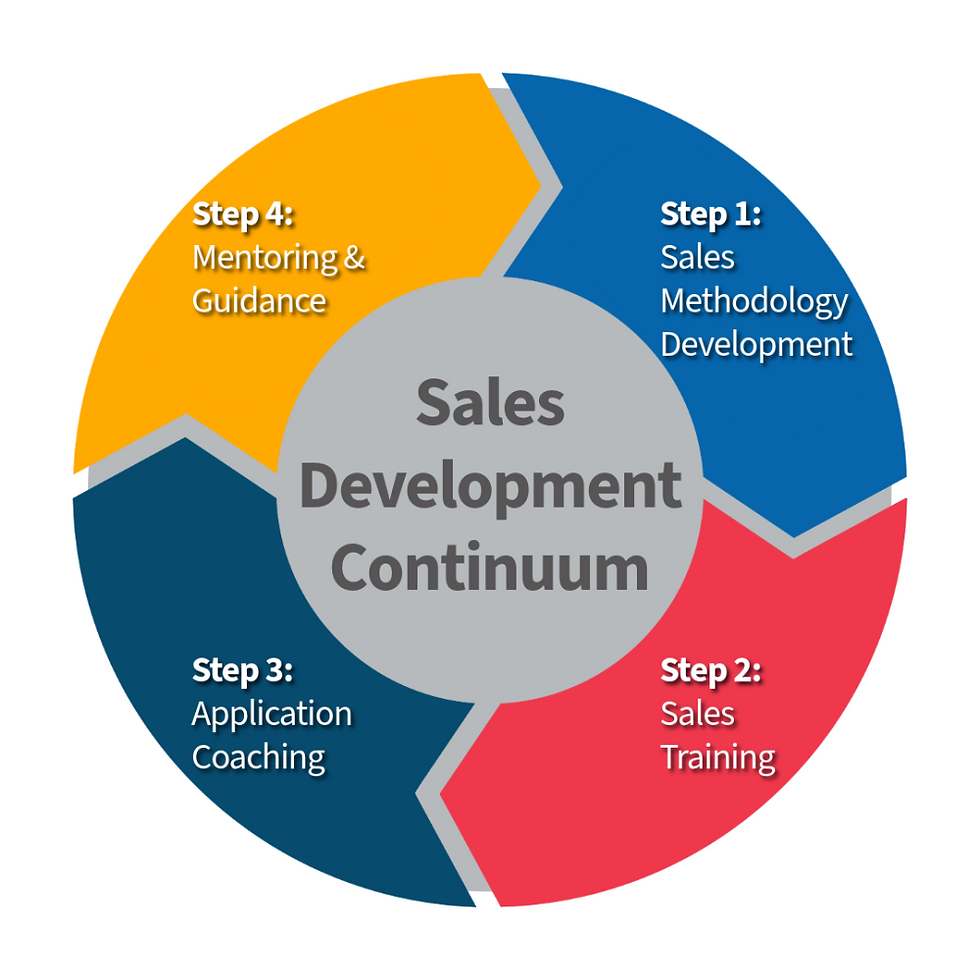
Read on to learn about my Sales Development Continuum methodology as you assess the effectiveness of your current approach.
Let’s start by running through the purpose of each step on the continuum wheel and how they work together to maximize results.
STEP 1: Sales Methodology Development
During this step, the sales leader establishes their sales playbook to include things like go-to-market strategy, sales process, value proposition positioning, and more.
Once the sales methodology is developed, skill requirements and key accountabilities can be created to establish role clarity for the various positions in the sales department.
STEP 2: Sales Training
Next comes structured competency and skills training that is designed and delivered for your unique environment. The focus can range from core sales fundamentals to custom training that teaches your salespeople how to effectively embody your company’s sales methodology, tools, new product rollouts, etc.
A proper sales skill gap analysis is necessary to design the right sales training approach for each seller on your team. Your team needs to be equipped with the right sales skill foundation before more advanced training can have a positive and lasting effect.
STEP 3: Application Coaching
Application Coaching becomes essential when sales theory is applied to real-world sales execution. This is a critical sales development step often overlooked.
Unlike sales training, sales coaching involves the sales leader partnering with their sellers in live selling situations or behind the scenes to improve an individual’s performance and drive consistent success.
Sales Coaching isn’t an event; it’s an ongoing core function of sales leadership.
To explore various selling scenarios I’ve found benefit the most from sales coaching, check out my previous article titled, “Why It’s Time to Redefine the “Sales Ride-Along”.
STEP 4: Mentoring and Guidance
No matter how experienced or successful your salespeople are, routine 1-on-1 meetings help them achieve better results while fostering a self-accountable sales culture.
This is the time when sales leaders provide guidance for maneuvering internal and external sales obstacles, review action plan progress, check-in on sales metrics achievement, etc.
We recommend 1-on-1 meetings that follow a consistent frequency and structure such as…
· 05-mins: Seller provides recap on outcomes from their prior 1-to-1 action commitments.
· 45-mins: Check-in on key performance levers and provide guidance to overcome roadblocks.
· 10-mins: Seller commits to their next set of short-term action plans.

Defining Training Areas That Make The Most Impact
Sales Training is a lynchpin within the Sales Development Continuum so defining “the right” areas to focus on for training is a key planning aspect you need to get right.

I find most sales leaders have not clearly identified the mix of traits and talents needed to succeed in each of their varying sales roles. This creates a fundamental problem when you set out to improve sales skills through the investment of training.
You need to be able to answer… What specifically are you training them to do? What sales tools do they need to be effective using? What are the key accountabilities and metrics associated to each role to monitor progress?
Once you know what your salespeople should be doing, the tools they need to be effective, and the essential skills needed to close more opportunities; then it is on you to make sure they have the support needed to get there.
If you'd like to dig deeper into one of my techniques to uncover sales skills competency gaps, you may find it helpful to read a previous article I wrote called “Reveal Your Sales Skill Gaps with the Customer Journey”.
How a Fractional Sales Leader Can Help You Fill Skills Gaps
I help expedite defining the best sales development plan for your team. My job is to evaluate sales organizations and diagnose foundational problems that can cause underperformance.
That can involve a combination of people, process, systems, and leadership breakdowns.
Once the gaps are defined, I collaborate with the owner or sales leader to establish a plan to address roadblocks in a manner that delivers results quickly. Although this commonly includes a sales training element, it’s seldom that training alone gets the job done.
If you think a Fractional Sales Leader might be the right solution to help improve your sales team, I welcome you to contact me at (713) 907-6310 or mprive@slictexas.com or book a call through my Scheduling Tool.

I am part of a national group of Senior Sales Leaders who collaborate to share insights like the examples shown in this article. We formed because of our shared passion to help business leaders exponentially expand their revenue.


Comments